
Navigate Article 6 and CORSIA markets with confidence
From host-country risk scoring to comprehensive LoA tracking and forecasts - assess CORSIA supply, demand, and compliance risk in one place.
Key questions market participants need to answer
Get a structured view of supply and demand fundamentals, comparable risk assessments, and forecasts so you can move with confidence in a market defined by corresponding adjustments.
Will these credits actually be authorized?
Track LoAs, corresponding adjustment pathways, and host-country risk.
How scarce will CORSIA-eligible supply become?
Monitor supply pipelines, airline demand, and future compliance pressure.
What kind of risks are we exposed to?
Assess sovereign, delivery, pricing, and policy risk in one place using structured scoring frameworks.

What sets the Article 6 & CORSIA Hub apart
Typical compliance intelligence

Comprehensive Analysis
Defend multi-year budgets
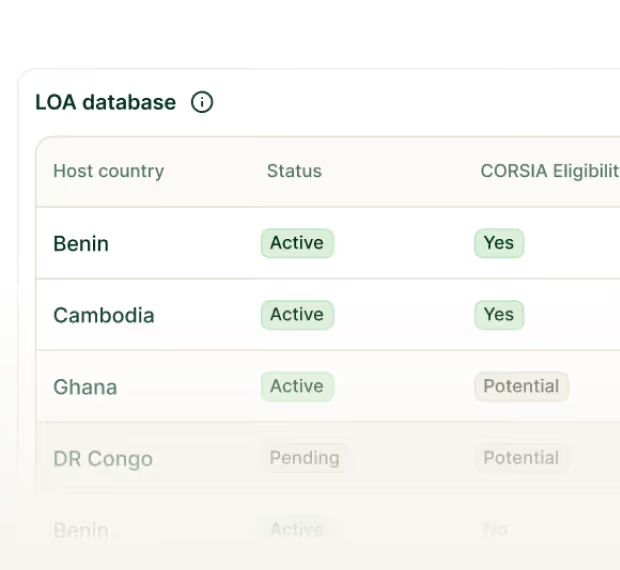
A comprehensive database tracking the status and delivery risk of existing LoAs and CAs — updated as the market moves.
Host-country risk scoring
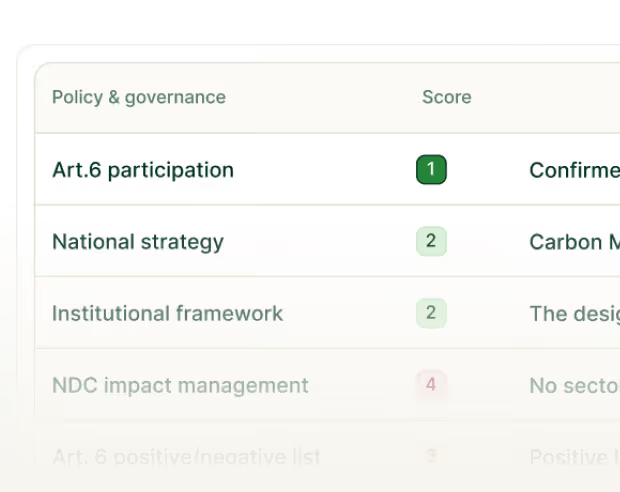
Structured scoring of each host country's willingness and ability to authorise adjusted credits, covering strategic clarity, reporting quality, institutional capacity, and overselling risk.
Supply, demand & price forecasts
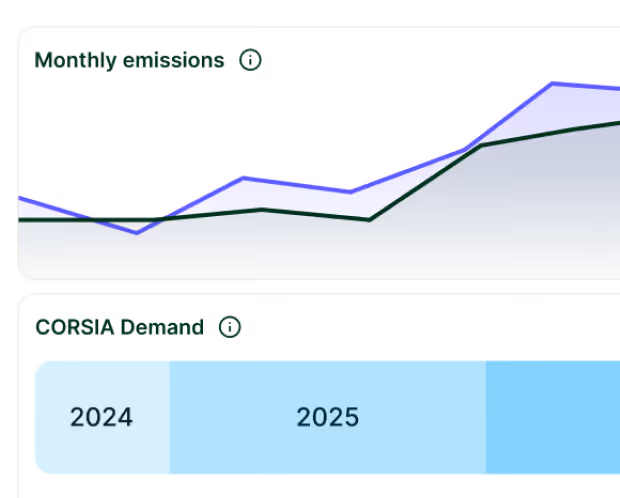
Bottom-up CORSIA supply and demand forecasts, plus a scenario explorer for sensitivity testing against key market assumptions.
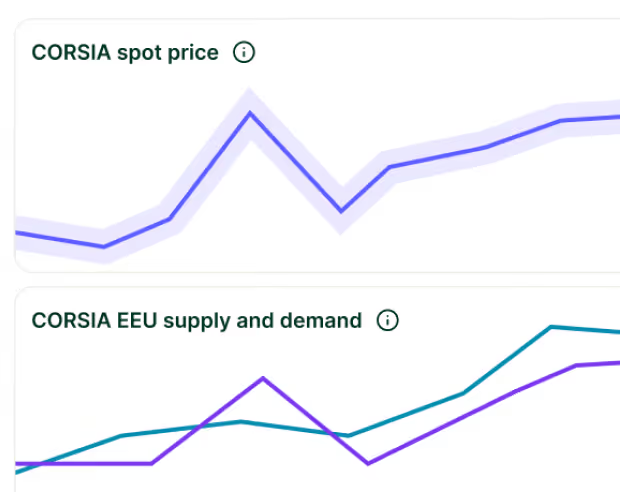
Demand and compliance fundamentals
Continuously updated aviation emissions data, demand fundamentals, jurisdiction-level compliance penalties, and SAF/LCAF economics - all in one place.
See the Article 6 & CORSIA Hub in action
From comprehensive CORSIA fundamentals data to host-country risk scoring - see how Sylvera’s Article 6 & CORSIA Hub turns fragmented data into the intelligence you need to act with confidence.
FAQs
A report answers one question, once. The Hub is a live, structured intelligence engine. Demand and supply forecasts, LoA tracking, futures pricing, sovereign risk and airline exposures are all updated as the market moves. Every datapoint is traceable to its source, so the output is auditable, defensible and shareable with an internal investment committee or regulator.
We provide risk assessment for 75+ countries. Coverage spans every CORSIA-eligible programme - Verra, Gold Standard, ACR, CAR and ART TREES today, with GCC, FCPF and Premium T-VER in the pipeline - and every host country that has issued, or is preparing to issue, Letters of Authorisation. The Hub is programme-agnostic: we assess each mechanism against the rule text, not the market narrative.
We assess 14 metrics that combine LoA policy, authorisation history, institutional capacity, NDC conditionality and white-list criteria (e.g. EU and national quality filters). Each risk score is broken down into its underlying components so you can see exactly why a country screens high or low, and stress-test assumptions against your own thesis.
CORSIA futures pricing is delivered through our partnership with ICE. LoA and CA pricing by host governments is aggregated from Sylvera-tracked transactions and public disclosures. Spot pricing for CORSIA-eligible credits draws on Sylvera's existing Market Intelligence price observations and estimates.
Yes. Subscribers get Sylvera's policy view on key trends, market commentaries for Article 6 and CORSIA, periodic data briefings, a full modelling report, and a quarterly webinar series hosted by our policy team - so data and expert interpretation arrive together.
As a dashboard inside Sylvera's Market Intelligence platform, with structured outputs via the Sylvera API for customers integrating into their own tooling. Every deliverable carries a full audit trail of inputs, source references and confidence levels - ready to share with an internal committee or external regulator
Airlines modelling CORSIA exposure, sovereigns structuring ITMO supply, developers routing projects through authorisation, traders pricing CORSIA-eligible credits, investors and offtakers diligencing adjusted-credit claims, and insurers underwriting sovereign delivery risk.
A corresponding adjustment is the accounting step that stops the same tonne of CO2 being counted twice. Under Article 6 of the Paris Agreement, when a country sells emission reductions for use abroad (for example into CORSIA), it has to add those tonnes back to its own greenhouse gas inventory. The buyer can then claim the reduction without the host country also counting it toward its national climate target.
For CORSIA Phase 1, units must have a corresponding adjustment or an LoA along with insurance against the possibility of the corresponding adjustment not being applied.
A Letter of Authorisation is the document by which a host country government formally permits specific carbon credits to be used internationally. The LoA identifies specific details, such as the project, vintage, volume, and approved end-use (such as CORSIA, an Article 6.2 bilateral deal, or the voluntary market).
Without an LoA, the registry cannot tag the credits as authorised and the host country cannot apply the corresponding adjustment. In practice the LoA is currently the main bottleneck on supply of CORSIA-eligible credits: ICAO has approved several crediting programmes, but each batch of credits still needs an LoA from the host country.
A credit must clear three checks set by ICAO's Technical Advisory Body:
- Programme. The credit must come from a crediting programme on ICAO's approved list, and under a methodology within that programme's approved scope. ICAO publishes the current list; it includes ART TREES, ACR, CAR, Verra, Gold Standard, and Global Carbon Council, each with specific conditions.
- Vintage and phase. The credit must fall within the eligible vintage window for the current phase. The Pilot Phase (2021-2023, voluntary participation) accepted vintages from 2016 onward. The First Phase (2024-2026 compliance) requires vintages from 1 January 2021 onward.
- Authorisation and corresponding adjustment. The host country must have either applied a corresponding adjustment to the credits or have issued a Letter of Authorisation for which the project developer has secured insurance against the possibility of the corresponding adjustment not being applied.
The underlying quality criteria the Technical Advisory Body assesses include additionality, permanence, accurate quantification, no leakage, no double counting, and governance requirements on the crediting programme.
Book a demo
Explore the carbon data powering real-world investment and procurement decisions.